
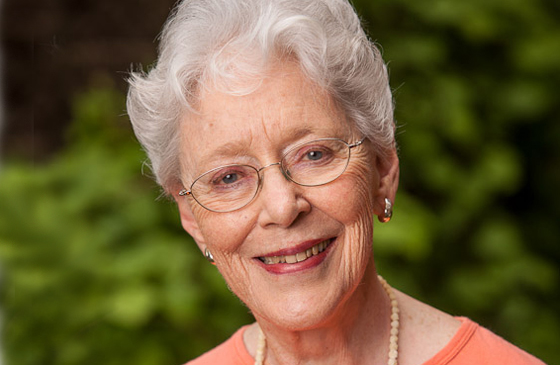
This longtime contributor’s life as a writer has been a journey that became the very soul of this magazine.
Unlock a world of inspiration right in your inbox! Sign up for our newsletters today and get uplifting insights, powerful stories of faith and more delivered directly to your email.
I have known Elizabeth Sherrill since I started at Guideposts in 1984, but I knew her by reputation before that. To say I was in awe of her gifts as an editor and writer would be only a slight overstatement. She was the toughest editor I ever wrote for.
When you thought you had done your best on a manuscript, Tibby—as we know her—was just getting started. She’d take your opus and cut it down to a one-pager. “This works nicely now, Rick.” Ouch! A hard way to learn but probably the best. And Tibby was the best.
For all the lasting influence Tibby imparted to Guideposts in her nearly seven decades as a contributor, retiring only recently, she was thoughtful and reserved in her manner, quiet-spoken for a writer of such editorial and spiritual conviction. Tibby was as kind and compassionate a person as she was tough as an editor.
Behind that unassuming exterior is the heart, faith and voice of Guideposts. Amazing then that she was not a person of faith when she arrived at Guideposts. (More on that in a bit.) She was a writer looking for a gig.
That was in 1951, just six years after Norman Vincent Peale founded the magazine with his wife, Ruth Stafford Peale, and one year before he would publish The Power of Positive Thinking, that best seller of spiritual well-being.
For most of those seven decades, Tibby worked alongside her beloved husband, John, also a longtime contributor. Do you love Guideposts’ vivid first-person stories full of heartfelt spiritual struggles and lessons? Do you feel as if you are right there with the writer when you read a Guideposts story? Do stories move you to tears or inspire you to take a step forward in your own spiritual life?
Thank Tibby Sherrill.
She’s the one who shaped and modeled Guideposts’ distinctive voice and approach to storytelling. She shared her own often deeply personal stories, and she helped countless others do the same. Generations of writers and editors learned from her at the Guideposts Writers Workshop, of which she was a founding editor and lead teacher. And what a teacher!
Today, at 93, Tibby’s vision loss prevents her from doing much writing or even reading e-mails. We felt it was high time to do what she would never do herself: pay tribute to her distinguished career and shine a light on how she shaped the Guideposts you know and love today.
Like many other Guideposts editors and writers, I first got to know Tibby at the Writers Workshop in Rye, New York. In 1984, I was about to start my job with the magazine as an assistant editor. All new staff editors are required to attend the workshop, so there I was, alongside the winners of that year’s contest, in the Wainwright House library. I stared at the book-lined shelves and the frayed rug on the floor, not quite sure what I was doing there.
I’d graduated from Princeton University a few years earlier and done a fair bit of writing. I figured I didn’t have much to learn.
Tibby proved me wrong.
I had to listen carefully to hear everything she said. She spoke softly and deliberately as she laid out a clear and deceptively simple vision of what made a great story.
Tibby’s lessons seem obvious, yet you would be surprised by how many writers—even professional writers—fail to observe them. She taught that a Guideposts story should begin when a narrator’s problem is most acute and show, step by step, scene by scene, how the problem is resolved with God’s help. She called that starting point the contract with the reader and reminded us that the reader had an expectation of a story in Guideposts. It was our mission as writers and editors not to disappoint.
To Tibby, that contract had almost the same weight as a legally executed one. She taught that much of a writer’s work is trimming away extraneous filler—like shards of marble—to reveal the story hidden inside a block of stone. No wonder one group of her students refers to itself as the Marble Shapers.
Tibby’s most insistent lesson: The heart of every Guideposts story should be a helpful piece of spiritual wisdom, one that the reader can take away and apply to their own life. How many other magazines have such a service-oriented mission?
I called Tibby not long ago at the retirement community in Massachusetts where she lives.
“I listen to books now,” she says. “I find I actually read even more than I used to because I can listen to an audio book as I make the bed and do chores.”
I suspect her discernment and insight into other people’s lives was fostered by her father, who worked as a private investigator. Her natural reserve became an asset when she embarked on a career as a writer. She was the quiet, attentive, patient interviewer you just couldn’t help revealing your deepest self to.
Her partner in work and life was her beloved John. Outgoing, exuberant, an instant friend, he proved that opposites do attract.
They met in 1947, just after World War II. John had served in the march through Italy. He was returning to Europe to study. Tibby, also a student, was on board the same transatlantic liner. It was love at first sight.
They married in Geneva, where they were attending school, and Tibby got a preview of what was in store when she became a Guideposts writer interviewing celebrities.
A few days before the wedding, an important visitor arrived in Geneva to give a speech about the United Nations: Eleanor Roosevelt. Tibby and the former First Lady wound up talking for more than an hour. “She wanted to give John and me her blessing,” Tibby recalls.
The Sherrills returned to the U.S. in 1950. They had a young child and college debts. “We needed to find work,” Tibby says. John tried freelancing travel articles but found that they didn’t pay, so he took a job writing for Guideposts.
The irony? At that time, John and Tibby were not people of faith. The job was a paycheck, nothing more. John, the son of a seminary professor, figured he could wing it.
Tibby struggled with her role as a housewife. She wanted to write, and she began to help John with his stories. Len LeSourd, Guideposts’ editor-in-chief at the time, had no idea that more than a few of the stories handed in were Tibby’s work.
“Then I was in Los Angeles by myself doing an interview—I think it was Alfred Hitchcock,” Tibby says. “Len called and told me he needed the story right away. I wrote it up and sent it to him. He seemed a little stumped. ‘You wrote this,’ he said. ‘Without John.’ ‘Yes,’ I said.”
Perhaps now it’s a humorous story about sexism. At that time, however, the professional barriers deepened Tibby’s lifelong struggle with depression. The mother of three children by this point, she felt isolated and torn between her desire to be a good parent and her sense of vocation. The conflict drove her into a deep depressive episode.
“John understood what I needed better than I did,” she says. “He gave me two hours a day in my room to myself. We could hardly afford it, but a caregiver would come in for two hours and give me a break. Over time, I became myself again.”
But what about faith? A few years after starting at Guideposts, John discovered a skin growth on his ear. A doctor removed it. John and Tibby thought everything would be fine. But a biopsy revealed he had melanoma.
The couple drove to the LeSourds’ house in the New York City suburbs, looking for comfort. Len’s wife, writer Catherine Marshall, knew about John’s spiritual ambivalence, and she did not mince words. “You must believe that Jesus was God,” she said.
On their way back home, “at a stop sign,” Tibby recalls, all at once John said, “I believe that Jesus is God.
“What does it feel like?” Tibby asked—the quintessential reporter.
“A little like dying,” John said. They visited their neighborhood church and talked to the pastor. He led them into the sanctuary, put his hand on John’s head and read a prayer for healing from the prayer book.
“It was like a bolt of electricity went through John,” Tibby says. “I could feel it too.”
When John returned to Sloan-Kettering Memorial Hospital for surgery, there was no tumor left. He had been healed.
John and Tibby started attending that church and remained there until they moved to Massachusetts, a little more than a decade ago.
Tibby speaks of her own, quieter revelation of faith, which came into focus after one of the Guideposts Writers Workshops. Driving away from Wainwright House, she was suddenly overcome with a profound sensation of joy, one she had never known before and had never even imagined could exist—as if it came from outside this world. “Nothing existed but that joy,” she now recalls. It was the joy that comes from knowing and feeling God’s love.
Tibby says writing for Guideposts helped her discover that great love and make it real. Helping other people tell their stories of faith opened her eyes to how God was working in her own life. Their struggles were her struggles, their triumphs hers. Her spirit was nourished by their faith, and it grew.
She was a natural writer, the way some musicians are born with perfect pitch. Endlessly curious, she noticed everything and knew how to ask the questions that prompted people to open up. She put herself inside the minds and hearts of the people she wrote about. She could feel what they felt.
She taught her first workshop in 1967, shortly after Len LeSourd and Catherine Marshall conceived of the workshops as a way to boost the quality of faith-based writing in America. Her last workshop was in 2010. Those of us editors who have tried to take her place realize that her gifts as a teacher equaled her gifts as a writer. No one has labored so generously to pass on the verities of good Guideposts writing.
John’s and Tibby’s partnership lasted for 70 years. Shortly before what would have been their seventieth anniversary, they were in the midst of planning a road trip through Europe when John fell ill. He died that December, five years ago.
“I think of him every day,” Tibby says. Then, correcting herself, she says, “Every moment.”
She takes great comfort in the vivid faith John had in a life eternal, one in which she knows she will join him. She herself has a vibrant prayer life, remembering her children, grandchildren and great-grandchildren. In fact, that day she and I spoke on the phone, she had just dialed into the morning prayer service at her church, something she does every day.
I will have to read this story to Tibby over the phone, the way she would read stories she’d written for others, making sure every detail was right. What will probably be hardest for her to take in, though, is being the center of attention.
I will remind her that she should please sit still for it the way we writers sat still for her editing and teaching. Guideposts would not be what it is without her.
For more inspiring stories, subscribe to Guideposts magazine.
Related Video
Author
Sign up for weekly inspiration